Tag: San Francisco

  • Size of the Pacific…& Where Is SF?

    How much of the earth is covered with the Pacific Ocean? It’s big. If you stand at San Francisco’s Ocean Beach and want to point to the far shore of the ocean, you could point out to sea.
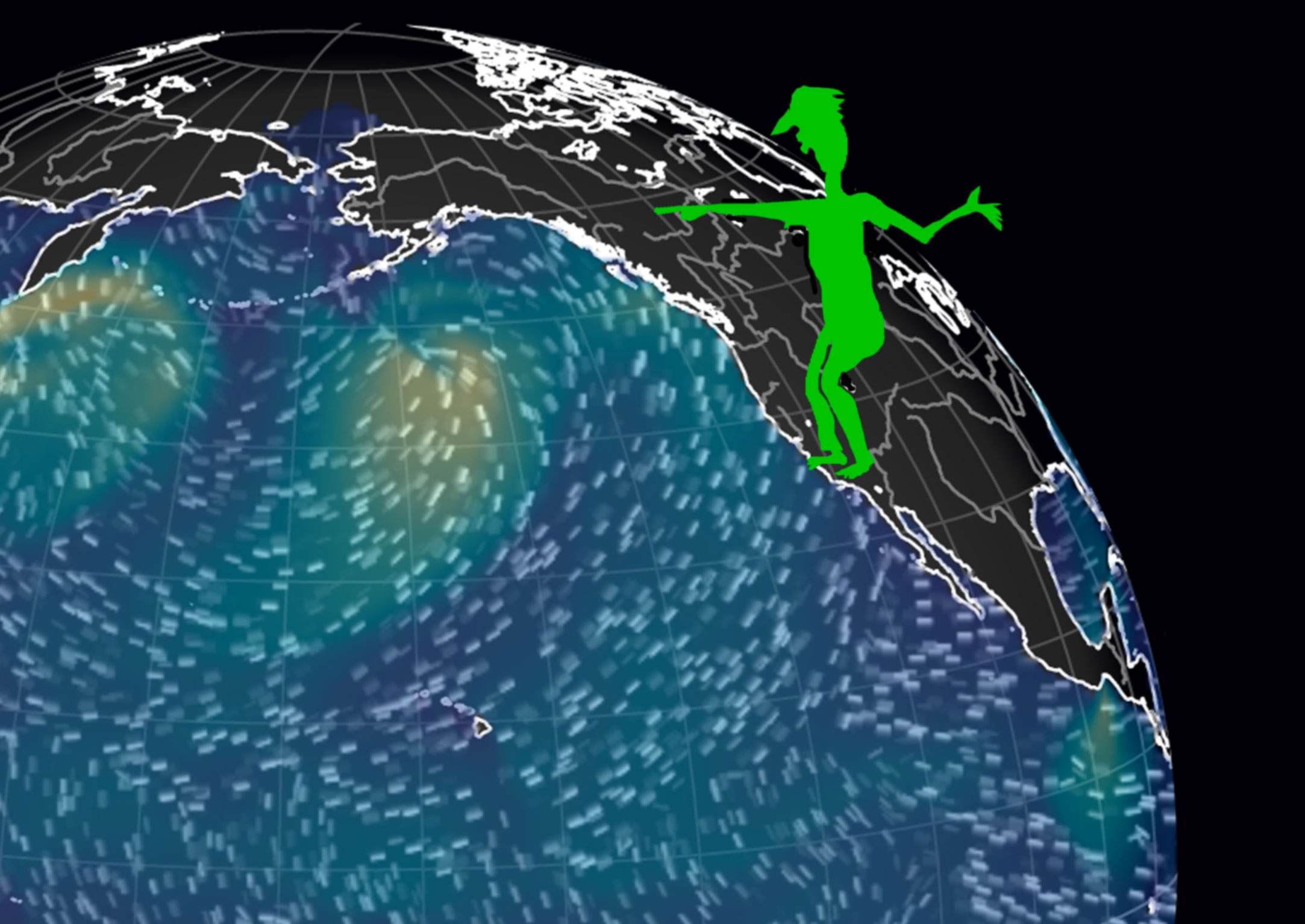
    But we can think of it another way. To point through the globe to the far shore, you’d point to the sand one stride ahead of you. The Pacific is that big. You could reasonably say it goes almost all the way to the other side of the world.
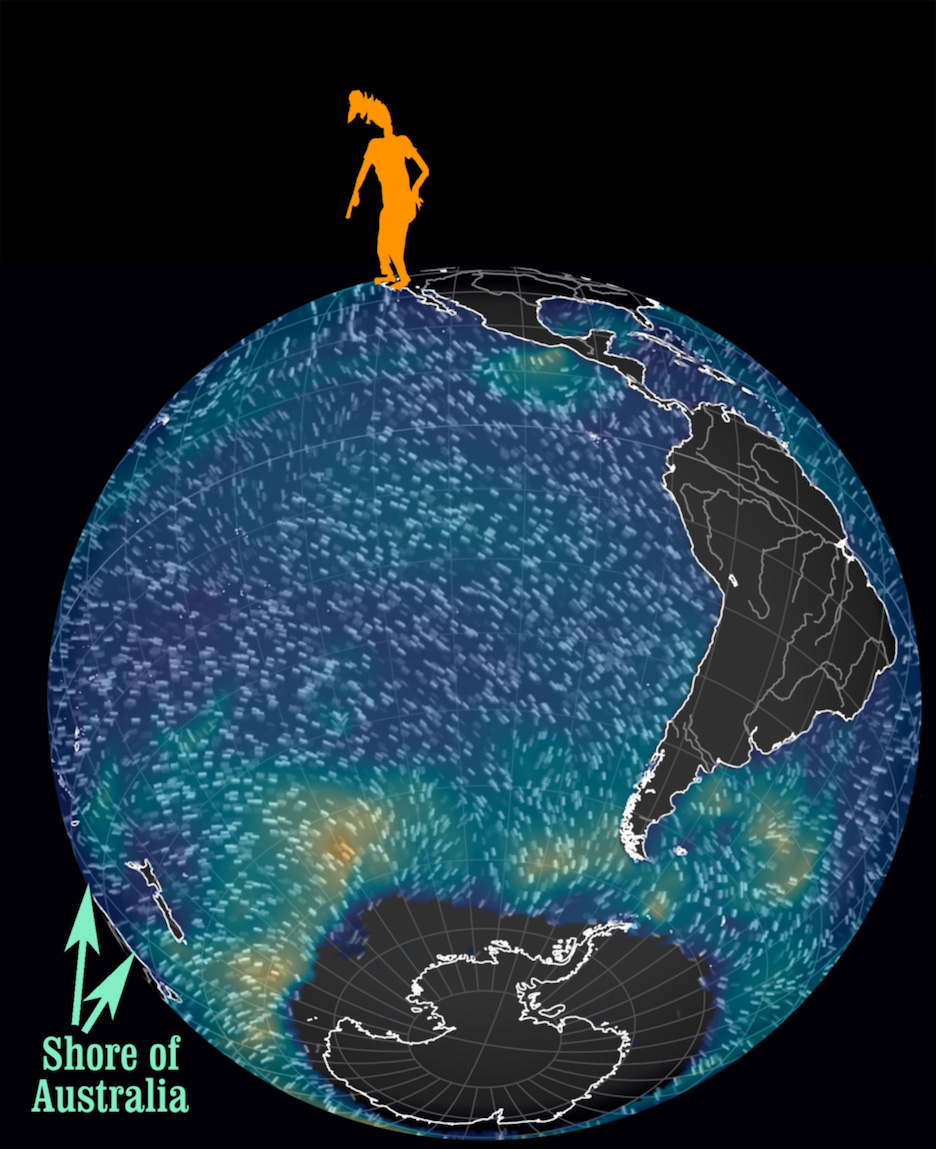
    If you are, say, five-foot-eight and have average feet, you’d point to a spot two and a half feet (30 inches) ahead of your toes (while facing the surf and keeping your arm straight). Try it.

    Assuming you’ll face west-by-southwest, it is true even if you aren’t right on the shore, say, from your house in Dogpatch. The minimal difference in your SF location compared to the size of the earth will only change the spot on the other side of the Pacific by the same few miles. Still pretty much the same jagged shoreline of Australia, the far side of the Pacific. G’day mate.

    If you instead point straight down, you’ll be pointing toward the exact opposite side of the world, in the Indian Ocean.
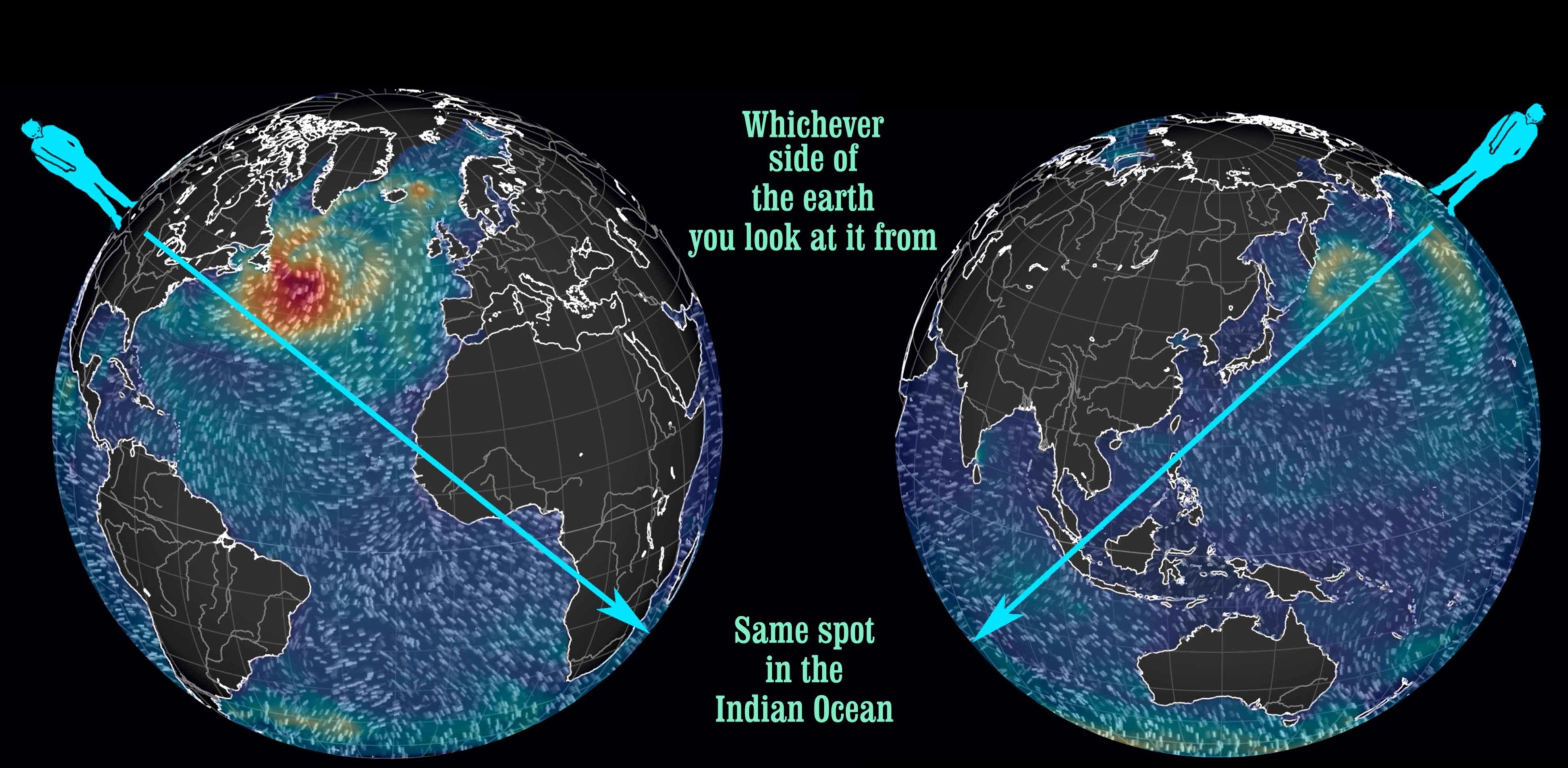
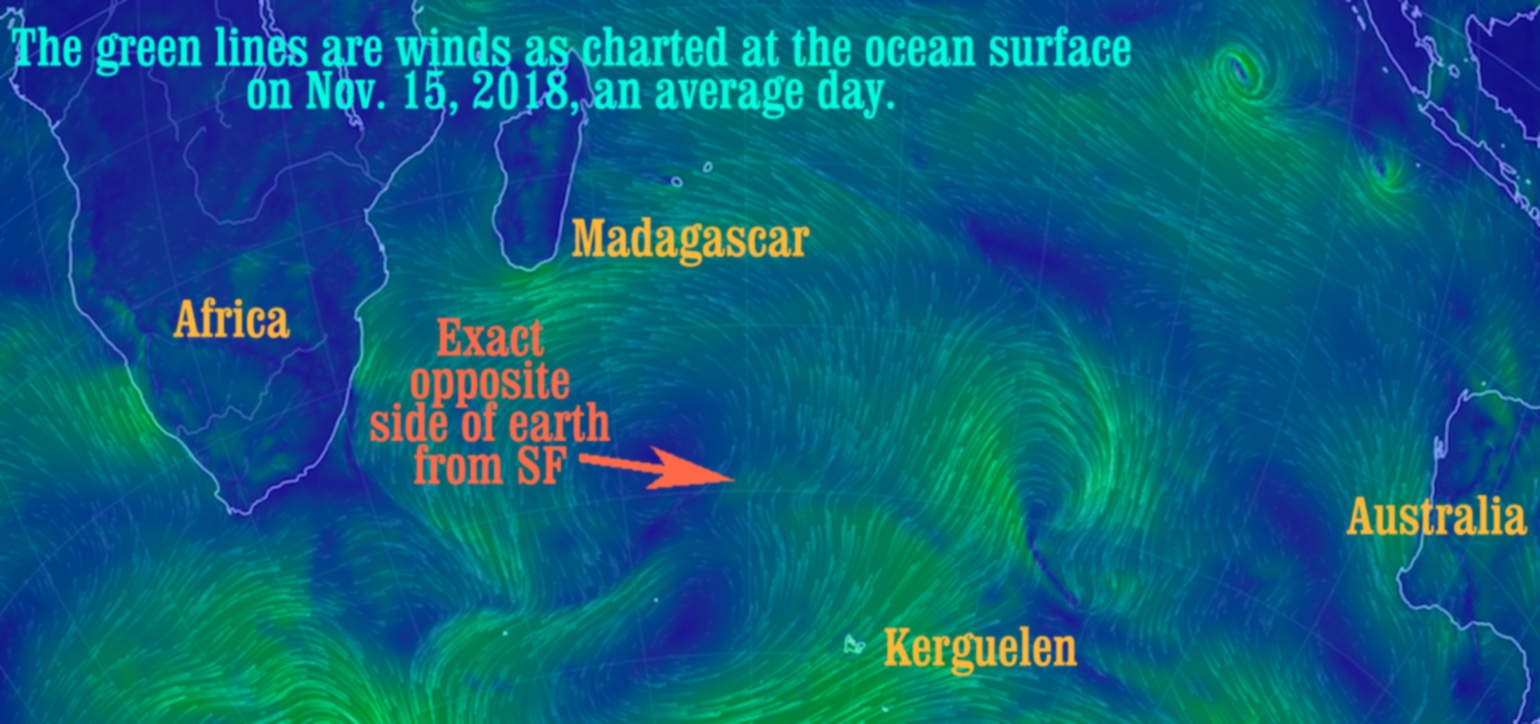
    The precise other side of the world from San Francisco (12,436.81 miles from Market & Van Ness) is right between Madagascar and the rather smallish, southerly island of Kerguélen (French). These two islands are 2,000 miles apart. It’s a very stormy sea around there. So you’d better imagine a decent boat before you think yourself to that spot.
    But now I’m wondering Why is San Francisco located at Van Ness and Market? Used to be that the “location” of San Francisco was in UN Plaza. Let’s go there!

    You can see a giant gray stone X with brass cross hairs and big brass latitude and longitude numbers denoting the spot. It has all been embedded on the ground near the UN Plaza Fountain since 1975 when the plaza was set up to commemorate the creation and signing of the UN Charter, here in SF.
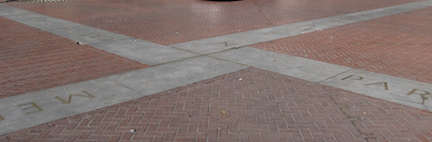
    While you’re at this spot, turn and look at the fountain with the granite slabs. Those piles of stone were designed to represent the continents in the oceans. The original fountain scheme had tides, too. Broke after just a few months, I’m told.

    Why was precisely that spot the location of SF? Why isn’t it anymore? It was in front of City Hall! You remember the one: It collapsed in 1906.

    The previous SF City Hall as seen from Market at 8th. It fell in 1906. Earthquake. Apparently things break around here.

    Atlases and charts based their intercity distances on city halls, for eons. Google Maps, however, uses the south corner of Market and Van Ness Streets instead. With everything at an angle to cardinal directions, it really is the south corner.

    Two things have changed since 1906. City hall moved and print gave way to…Google. Weird world where a private company gets to change the official location of San Francisco without anyone asking them to (as far as I know).
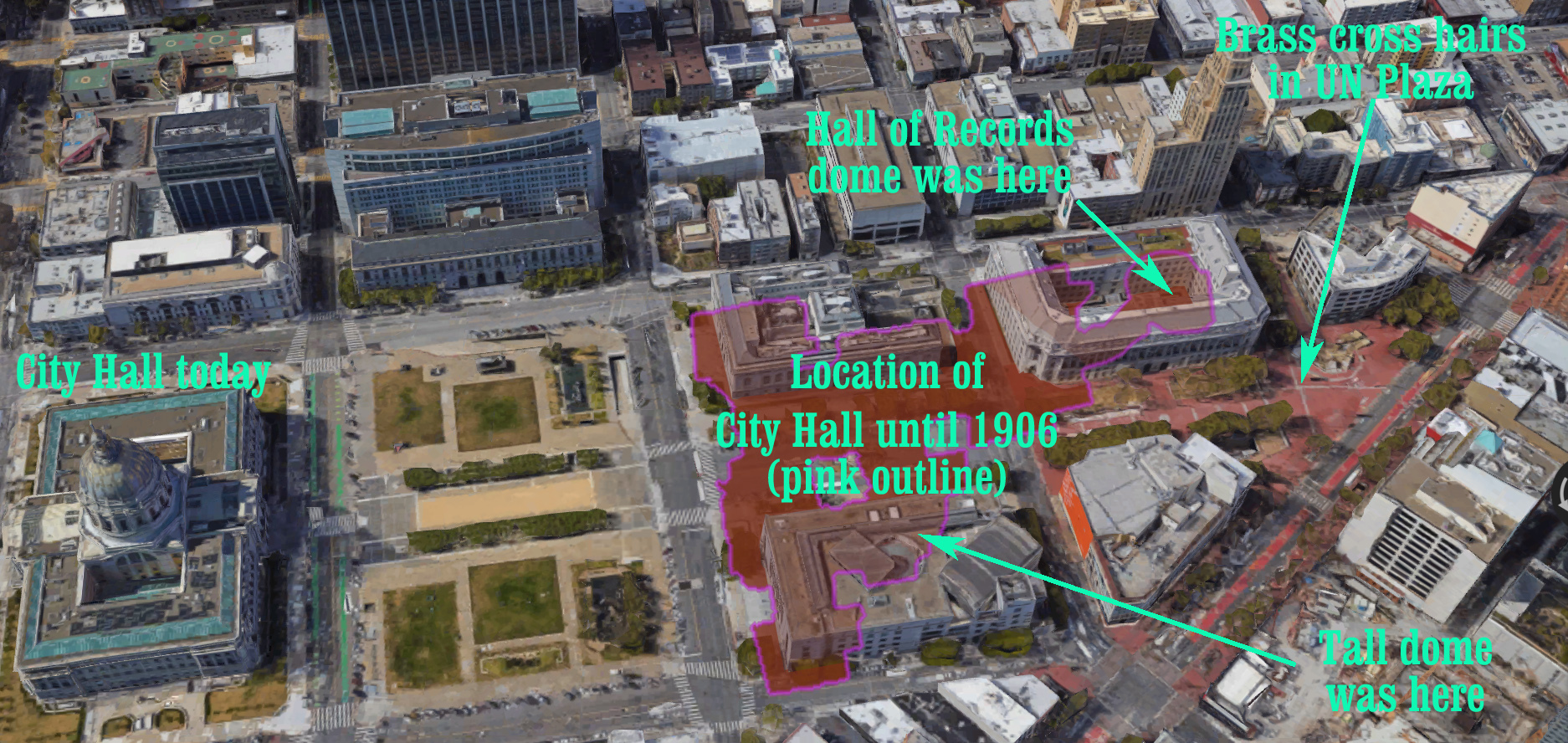
    I don’t really know why the cross hairs are not precisely where the front steps of the old city hall were. I suppose it must be that the correct location was taken up by the old-old federal building or by the rest of the UN memorial, where it quotes from the charter. Go read the quotes and cry. The world isn’t following it very well.

    But back to the Pacific Ocean.

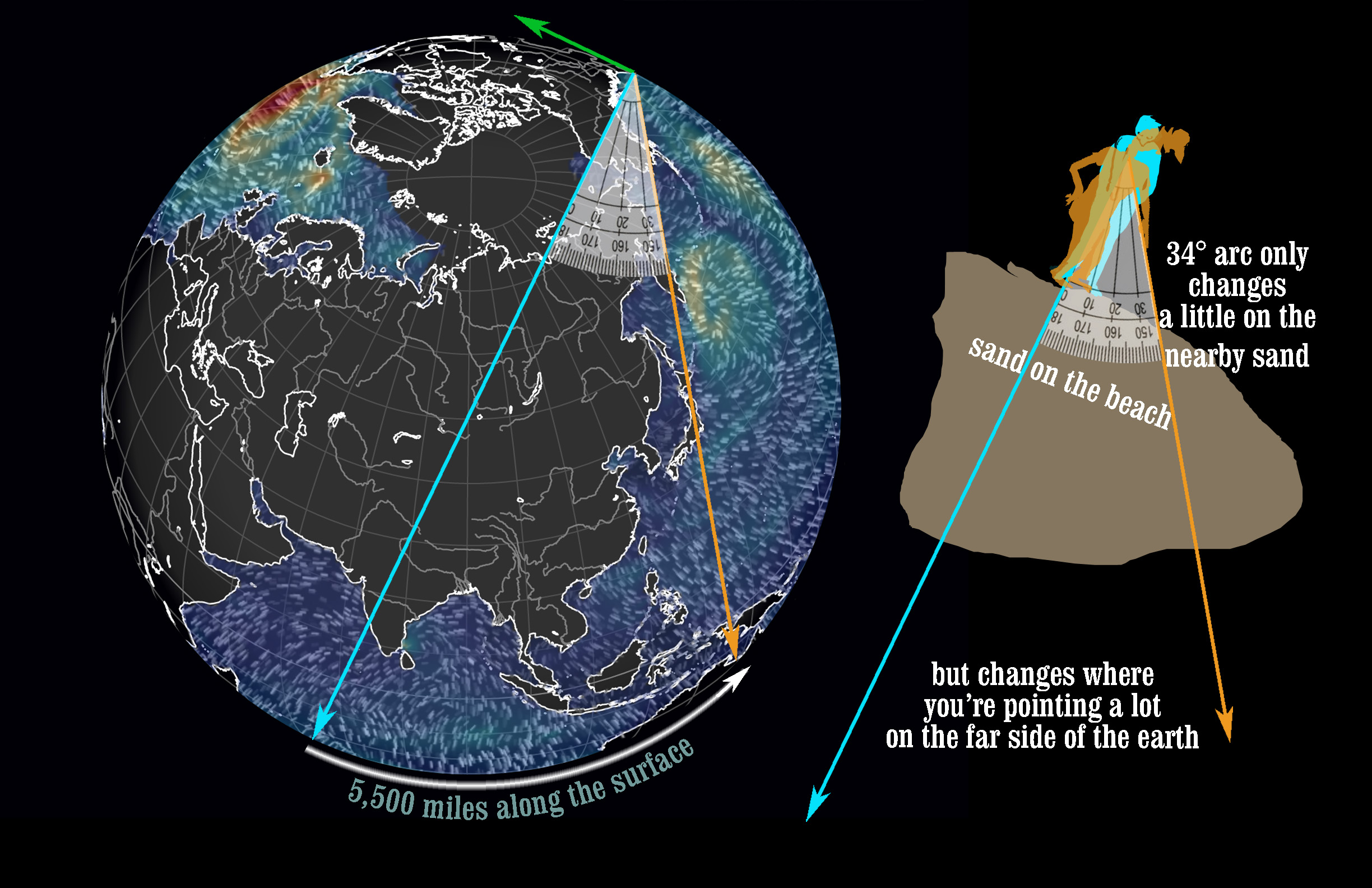
    For purposes of mind-traveling the other side of Earth, moving your body around the city is not as effective as moving your arm. Moving the angle of your pointing arm (from straight-down—the blue line) back to pointing one step ahead (the orange line) only moves 30-or-so inches on the ground near you. But since you’re moving your arm through a 34° angle, it shifts the spot you’re pointing towards, on the other side of the world, about 5,500 miles farther east along the surface (therefore closer to us). Australia.
     

  • Leaping Frog Fungus!

    I just learned more about why the project to get rid of the preggie test frogs has been failing. Which frogs? The African clawed frogs that live in Golden Gate Park in the Lily Pond. Apparently they were dumped there as a gesture of goodwill.

    Back in the 50s rabbits were all the rage for pregnancy tests. A pregnant woman’s urine would cause the rabbit to ovulate. Problem was that you had to kill the rabbit to find the result. Then bufo marine toads and African clawed frogs were found to accomplish the same thing without the sacrificial ritual. Frogs ovulate externally!

    So until the pee-on-a-stick test was developed, which directly senses the hormones in the urine, frogs were hanging out at medical labs doing their analytic good deeds. When they were phased out, the lab put them in the pond. All was well until a Myxophes faciolatus fungus came along from far continents.

    This pathogen caused all the aquatic life except the clawed frogs (who are immune) to die of chytridiomycosis. Now those clawed frogs aren’t such welcome Park guests because they’re carriers. If they hoppity hop to other ponds–death to all! If you’ve been by the Lily Pond in the past couple years, you’ve seen bleach attacks and lime dumping to try and kill off the frogs along with their pal M. faciolatus.

    I just got word that the frog can hybernate (and the eggs can survive drought) for five years. So much for that brutally easy fix. What will next happen in this strange tale?

    ———–

    Reply from Eric Mills: New Year’s Day 2015 (via Jake Sigg)

    Was pleased to see your post re: the African clawed frogs in GG Park’s Lily Pond. That population was discovered by personnel from the nearby Cal Academy of Sciences back in 2003. As noted, these non-native and prohibited frogs are notorious carriers of the dreaded chytrid fungus (Bd), thought to be responsible for the extinctions of some 200 frog and other amphibian species worldwide in recent years. It’s likely they were dumped in Lily Pond by researchers at nearby UCSF

    Thus it was that our dysfunctional State Dept. of Fish & Game (now Fish & Wildlife–aren’t fish wildlife, too?) immediately jumped on the issue, and a clean-up was planned for the summer of 2003, a “seine and drain” affair, with all the frogs, tadpoles and eggs being strained and destroyed. (Lily Pond is a small former quarry, with a rock bottom, and no outlets, surrounded by hills.) A relatively simple job, yes? Yet only a few hours before the operation was to get underway, it was abruptly cancelled by a panicky DFG. Their reported excuse? They couldn’t guarantee that all the frogs would be caught and destroyed.

    So for the past 12 years Lily Pond has been open to the public. Any kid with a dipnet could have dispersed this highly invasive species. Indeed, we have seen herons carry away live frogs. One live frog was discovered in the nearby AIDS Memorial Grove.

    So the Dept. and the SF Rec & Parks have been dragging their collective feet all these years, interspersed with periodic and ineffective seining of the pond. I can hardly wait for the lawsuits, once these critters disperse, as they already likely have. There’s also a small population of threatened red-legged frogs in the nearby Arboretum.

    I just finished famed biologist E.O. Wilson’s latest book, “THE MEANING OF HUMAN EXISTENCE,” in which he posits that the human species is “innately dysfunctional.” Hard to argue with that.

    Meanwhile, our Dept. of Fish & Wildlife continues to import some TWO MILLION non-native bullfrogs into California every year for human consumption (mostly in the Chinatown live food markets, kept in horrendous conditions). Worse, the majority of the bullfrogs test positive for the chytrid fungus. Many are bought and released into local waters by “do-gooders” and religious sects for “animal liberation” ceremonies, where they prey upon and displace our native species, while spreading diseases, including the chytrid fungus. (The bullfrogs generally do not succumb to the disease, but they certainly do disperse it.)

    PARTIAL FIX: The DFW could easily put a stop to the issuance of the frog/turtle import permits. They have the authority. Indeed, back in 2010 the Fish & Game Commission voted 5:0, instructing the Dept. to stop issuing import permits. Only weeks later the then-Director, John McCammon, announced he would continue the permits on a month-to-month basis. Challenged, the Dept. could only weakly respond, “The Director acts at the pleasure of the Governor.” Say What?! So much for the democratic process, while we continue to lose our native wildlife.

    Write to the DFW and demand that these permits cease immediately: Chuck Bonham, Director, Dept. of Fish & Wildlife, 1416 Ninth Street, Sacramento, CA 95814; email – director@wildlife.ca.gov. The Secretary of Resources, John Laird, may be written at the same address, email – secretary@resources.ca.gov

    ———–

    An earlier note from Jake Sigg to Bay Nature, regarding this article:

    Your note in the October-December 2013 issue regarding African Clawed Frog and chytrid fungus gave the impression that the ACF’s days in Golden Gate Park are numbered. That is not correct. The issue has become embroiled in intra-agency infighting, and the dread scenario of this frog and its devastating chytrid fungus disease (to which ACF is immune) becoming at large in California is all too real. The interface between politics and biology is an exceedingly uncomfortable place to be, with the latter always losing.

  • Atmospheric River Meditation in SF

    Here’s my 7-minute storm video, meditative and exploratory rather than my usual strict documentation.

    San Francisco was blasted by a few inches of rain in a single day on Thursday, Dec. 11, 2014. It was an ‘atmospheric river’ (AR) blasting at the coast like a fire hose. These “rivers” contain as much water as many Mississippis, wafting through the air about a mile above the sea from the equatorial region beyond Hawai’i.

    This one first blasted Canada and then Washington, then Oregon, then us (in essEFF), then Southern California.

    I’ve been researching the probable AR storm sequence of 1861 & 1862, as readers of this site will know, so I decided to go out and capture some images around town. It won’t appear especially dramatic to people from wetter climates, but the SF infrastructure and history of drought prepares us poorly us for this kind of thing.

    My friend John’s offices (Stripe) at Folsom and 18th Street are so flood prone they moved all the furniture upstairs! Last time a storm like this came, it flooded the area four feet deep. But he was spared this time!

    Music in this video is Aïya Aïya by Rachid Taha, who (quoting Wikipedia) is an Algerian singer and activist based in France. • Please support him and his brilliant work! •

    If you want to help do research on the AR of 1862, please let us know!